Panel upgrade quotes can look simple until the final bill arrives. Here's what the real cost looks like in Cook County, IL - before any surprises hit.
Share:
Summary:
You got a quote for a panel upgrade. Maybe it was $1,500. Maybe it was $2,800. Either way, you’re staring at it wondering: is that actually what I’m going to pay, or is this the number before the surprises start?
That’s a fair question – and in Cook County, it’s an especially important one. Between municipal permit requirements, utility coordination with ComEd, and the realities of older housing stock across communities like Cicero, Harvey, and Berwyn, there’s more to this project than swapping out a box. Here’s what the full cost actually looks like, and what to watch for before work begins.
For most homeowners upgrading from 100-amp to 200-amp service, the project cost typically falls between $1,300 and $3,000. That range reflects real variables – the age of your home, the condition of your existing panel, whether your grounding system needs work, and which Cook County municipality you’re in.
What a solid quote should include: the new main breaker panel, individual circuit breakers, proper grounding, labor, and the permit application. If a contractor’s quote doesn’t mention permits, that’s worth asking about directly. In Cook County, every panel upgrade requires a permit – no exceptions, no workarounds.
For a line-by-line breakdown of what a 200-amp upgrade costs in Chicago and the suburbs, see our 200-amp panel upgrade guide.
Here’s where a lot of homeowners get caught off guard. A panel upgrade and a service upgrade are related but not the same thing. The panel is the box inside your home. The service entrance is everything from the utility line coming into your house down to that panel – the meter, the weatherhead, the conduit, the service conductors. If your service entrance is undersized or deteriorating, it needs to be addressed at the same time. That’s a separate cost, and it involves ComEd.
In Cook County, ComEd handles the disconnect and reconnect of your utility service. That has to be scheduled in advance, and during peak seasons – summer storm season especially – their scheduling backlog can push your project timeline out by a week or more. We coordinate with ComEd proactively so that delay doesn’t fall on you.
The cost of a service entrance upgrade varies depending on what’s there now and what needs to change, but it’s not unusual for it to add several hundred dollars to the total project. It’s not a surprise if we tell you about it upfront. It is a surprise if nobody mentions it until we’re already on-site.
Beyond the service entrance, older homes across Cook County – particularly the brick bungalows built in the 1920s through 1940s that define neighborhoods in Cicero, Berwyn, Oak Park, and Chicago’s southwest side – frequently have grounding systems that don’t meet current code. When a permit is pulled, the inspection process will flag this. Bringing the grounding up to code is required work, and it adds to the total. It’s not padding – it’s a legitimate safety requirement that protects your home and your family.
This is also where knob-and-tube wiring becomes relevant. If your home still has it – and many Cook County homes built before 1940 do – the permitting process may trigger requirements to address it. Not always a full rewire, but potentially partial remediation depending on what the inspector finds. The point is to make sure you’re budgeting for what the project actually requires, not just the optimistic version of it.
If your home still has a fuse box rather than a breaker panel, the conversation is a little different. Fuse boxes aren’t just outdated – they’re a genuine liability. Many homeowners insurance carriers in Illinois will either surcharge your premium or decline to cover a home with an active fuse box. And if you’re trying to sell, a home inspector will flag it immediately.
Replacing a fuse box with a modern breaker panel in Cook County typically costs more than a straightforward panel-to-panel swap. The wiring configuration is different, the grounding work is more involved, and the scope of code compliance is broader. A realistic range for fuse box replacement runs from $1,800 to $3,500 depending on the home’s size, age, and current wiring condition.
The permit and inspection process applies here too, and it’s actually more thorough for fuse box replacements because inspectors know these homes tend to have more underlying electrical issues. That’s not a bad thing – it means the work gets done right and documented properly. But it does mean the project takes longer and costs more than a simple panel upgrade in a home with more recent electrical infrastructure.
One thing worth knowing: Cook County’s 130-plus municipalities each run their own building departments. Permit fees in one town may be $75. In another, they’re $250. Inspection timelines vary too. We’ve been working across Cook County long enough to know which municipalities move quickly and which ones require more lead time – and that knowledge directly affects your project schedule.
Want live answers?
Connect with a Jimco Electric expert for fast, friendly support.
The base cost of a 200-amp panel upgrade is the easy part to quote. What’s harder – and what separates a trustworthy estimate from a lowball number – is accounting for everything that can legitimately add to the total once work is underway.
Permit fees alone range from $50 to $300 across Cook County municipalities. That’s not optional, and it shouldn’t be a surprise. AFCI breaker requirements, GFCI outlet upgrades triggered by the permit, and potential drywall repair if new circuits need to be run through finished walls are all real line items that show up in projects regularly. A complete, honest quote addresses these possibilities before work starts – not after.
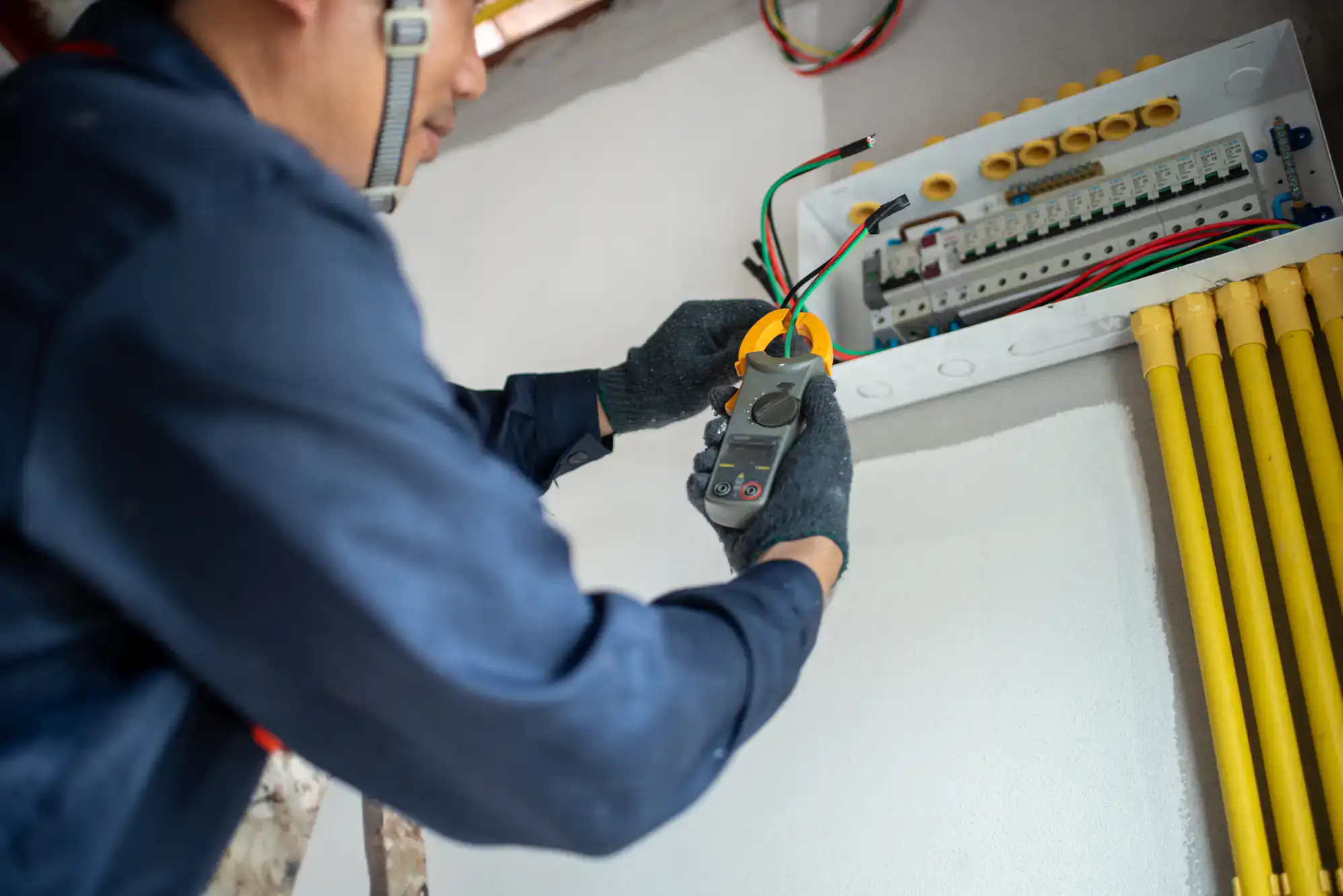
If you’ve gotten two or three quotes and they’re nowhere near each other, that’s not unusual – but it does require some explanation. The lowest quote is often low for a reason. It may reflect unlicensed labor, a plan to skip the permit, or an estimate that doesn’t account for the grounding work, service entrance evaluation, or code compliance requirements that a licensed electrician has to address.
In Illinois, electrical work on a main panel must be performed by a licensed electrician. That’s not a suggestion – it’s a legal requirement. Work done without a permit, or by someone without a current Illinois electrical license, can void your homeowner’s insurance, create problems in a future home sale, and – more importantly – leave you with work that was never inspected and may not be safe.
The difference between a $1,400 quote and a $2,400 quote often comes down to whether the lower number includes everything the job actually requires. A quote that looks attractive on paper but doesn’t mention permits, doesn’t address grounding, and doesn’t account for utility coordination isn’t a deal – it’s an incomplete picture of the project.
When you’re comparing quotes, ask each contractor directly: does this include the permit application? Who coordinates with ComEd? What happens if the inspector requires additional work? The answers will tell you a lot about whether the number you’re looking at reflects the real project or just the starting point.
The most effective way to avoid a surprise bill is to work with a contractor who does a real load evaluation before quoting, pulls the permit as part of the job, and tells you upfront what could change the price – before picking up a single tool.
A load evaluation matters because the right panel size for your home isn’t always 200 amps by default. If you’re running central air, an EV charger, an electric range, and a home office simultaneously, 200-amp service is almost certainly the right call. But if your home’s actual load doesn’t demand it, a good electrician will tell you that rather than upsell you on a bigger job. And if your situation calls for more – some larger Cook County homes with solar, EV charging, and all-electric appliances are moving to 400-amp service – that needs to be part of the conversation too.
Illinois homeowners also have access to federal tax credits of up to $3,200 for qualifying energy-efficient electrical upgrades, along with state-level rebates that can offset part of the project cost. These aren’t guaranteed for every panel upgrade, but they’re worth understanding before you decide on scope. We’re familiar with the local incentive landscape and can help you figure out what applies to your situation.
One more thing that’s easy to overlook: the power outage during installation. For a standard panel upgrade, you’re typically looking at four to eight hours without power. Most of the prep work happens while power is still on, which keeps the outage window as short as possible. It’s a manageable inconvenience – not a multi-day disruption – and knowing that upfront makes it easier to plan around.
We’ve been doing panel upgrades in Cook County for 25 years. That’s long enough to know what older homes in Cicero and Harvey tend to need, what the permitting process looks like in Morton Grove versus Midlothian, and how to give you a number that actually reflects the full project. We handle the permit application, coordinate with ComEd, and our work passes inspection the first time – because that’s the only way to do it right.
A main panel upgrade is a real investment – typically $1,300 to $3,000 for most Cook County homes, with additional costs that depend on your home’s age, your municipality’s requirements, and what the job actually turns up. The homeowners who end up frustrated are usually the ones who got a number without getting the full picture.
The goal isn’t to make this feel more complicated than it needs to be. It’s to make sure you know what you’re agreeing to before work starts, so the final bill isn’t a shock.
If you’re trying to figure out what your specific project will cost – or you’ve already gotten a quote that raised more questions than it answered – we’re straightforward to reach. Through our panel upgrade service, we’ll give you a clear, honest estimate based on what your home actually needs, not a number designed to win the bid.
Article details:
Share:
Continue learning: