Not sure which home car charging point is right for your Cook County home? This guide breaks down what actually matters before you buy or install anything.
Share:
Summary:
If you just got an EV — or you’re about to — the charger situation probably isn’t what you expected. You plug into the standard outlet in your garage, and your car charges at a rate that would take two full days to top off from empty. That’s just how Level 1 charging works, and for most people, it stops being acceptable pretty quickly.
The good news is that upgrading to a proper home charging point is straightforward when you know what you’re looking for. We’ve guided hundreds of Cook County homeowners through this process, and this guide covers the equipment that actually matters, what your home may or may not need, and how to avoid the most common and expensive mistakes we see when setting this up.
The charger that came in the box with your EV is a Level 1 unit. It runs off a standard 120-volt outlet and adds roughly 4 to 5 miles of range per hour. If you drive 40 miles a day, you need eight to ten hours of charging every single night just to keep up — and that’s assuming you get home early enough to plug in.
Level 2 chargers run on 240 volts, the same type of circuit your dryer or range uses. They add 15 to 40 miles of range per hour depending on the charger’s amperage and your vehicle’s onboard charger capacity. Most EV owners find they can fully replenish a day’s worth of driving in two to four hours. That kind of buffer changes how you think about charging entirely — you stop planning around it.
The answer depends on three things: how far you drive daily, what your vehicle can accept, and what your home’s electrical system can support. Most people focus on the first two and ignore the third — which is where the surprises come from.
On the vehicle side, every EV has a maximum onboard charging rate. A Chevy Bolt EV accepts up to 11.5 kW (48 amps). A Tesla Model 3 Long Range can accept up to 11.5 kW as well. A Hyundai Ioniq 6 goes up to 10.9 kW. A plug-in hybrid like a Toyota RAV4 Prime typically maxes out around 3.3 kW — meaning a 40-amp Level 2 charger is more than enough, and you’d never need to go higher. Matching your charger’s output to what your car can actually use is the first step to not overspending.
Consumer Reports recommends a minimum 32-amp Level 2 charger for most battery electric vehicle owners. That gives you roughly 25 miles of range per hour — enough to recover a full day of driving in about three hours overnight. Going up to a 40- or 48-amp unit makes sense if you drive long distances regularly or if you have two EVs sharing one charger.
One thing worth knowing: chargers rated above 40 amps must be hardwired by a licensed electrician. You can’t simply plug them into a NEMA outlet — the code doesn’t allow it. So if you’re looking at a high-output unit, a professional installation isn’t optional.
On the home side, the question is whether your electrical panel has enough available capacity. A 200-amp panel doesn’t automatically mean you have 200 amps free to use. If your home’s existing loads — HVAC, appliances, lighting — are already drawing 140 to 160 amps under peak conditions, adding a 40-amp EV circuit needs to be evaluated carefully. That evaluation is called a load calculation, and it’s the starting point for any honest assessment of what your home actually needs.
Both options deliver Level 2 charging, but they’re not identical — and the difference matters more than most people realize when they’re shopping.
A plug-in charger connects to a NEMA 14-50 outlet (the same type used for RVs and some ranges) and can be moved if you relocate. It’s a reasonable choice if you’re renting, if your landlord has already installed the outlet, or if you want flexibility. The limitation is that plug-in units are capped at 40 amps — roughly 9.6 kW — by electrical code. That’s perfectly adequate for the majority of EV owners, including most Tesla, Bolt, and Ioniq drivers.
A hardwired charger is permanently connected to a dedicated circuit and can legally operate at up to 48 amps — about 11.5 kW. That’s a 20 percent speed increase over a plug-in unit. Over the course of a year, that extra output adds up to meaningful range recovery time, especially if you have a longer daily commute or charge a larger-battery vehicle like a Rivian or Ford F-150 Lightning. Hardwired units also tend to be more stable — no GFCI outlet to trip, no plug connection to degrade over time.
For most Cook County homeowners who own their home and plan to stay, hardwiring is the better long-term choice. It’s cleaner, faster, and eliminates the one moving part — the plug — that tends to cause problems down the road. The installation cost difference between hardwired and plug-in is modest when you’re already having an electrician run a new 240-volt circuit, which you’ll need either way.
There’s also a safety angle. A hardwired installation done by a licensed electrician, with proper conduit routing and a dedicated breaker sized to 125 percent of the charger’s rated amperage (as required by the NEC), is simply more robust than a plug-in setup where the outlet and plug connection carry the full load every night for years.
Want live answers?
Connect with a Jimco Electric expert for fast, friendly support.
Cook County homes cover a lot of ground — architecturally and electrically. The North Shore has older colonials and bungalows with 100-amp service. Oak Park has beautiful historic homes that haven’t had their panels touched in decades. Newer construction in the southwest suburbs often has 200-amp service already in place. Where your home falls on that spectrum affects what your installation will look like and what it will cost.
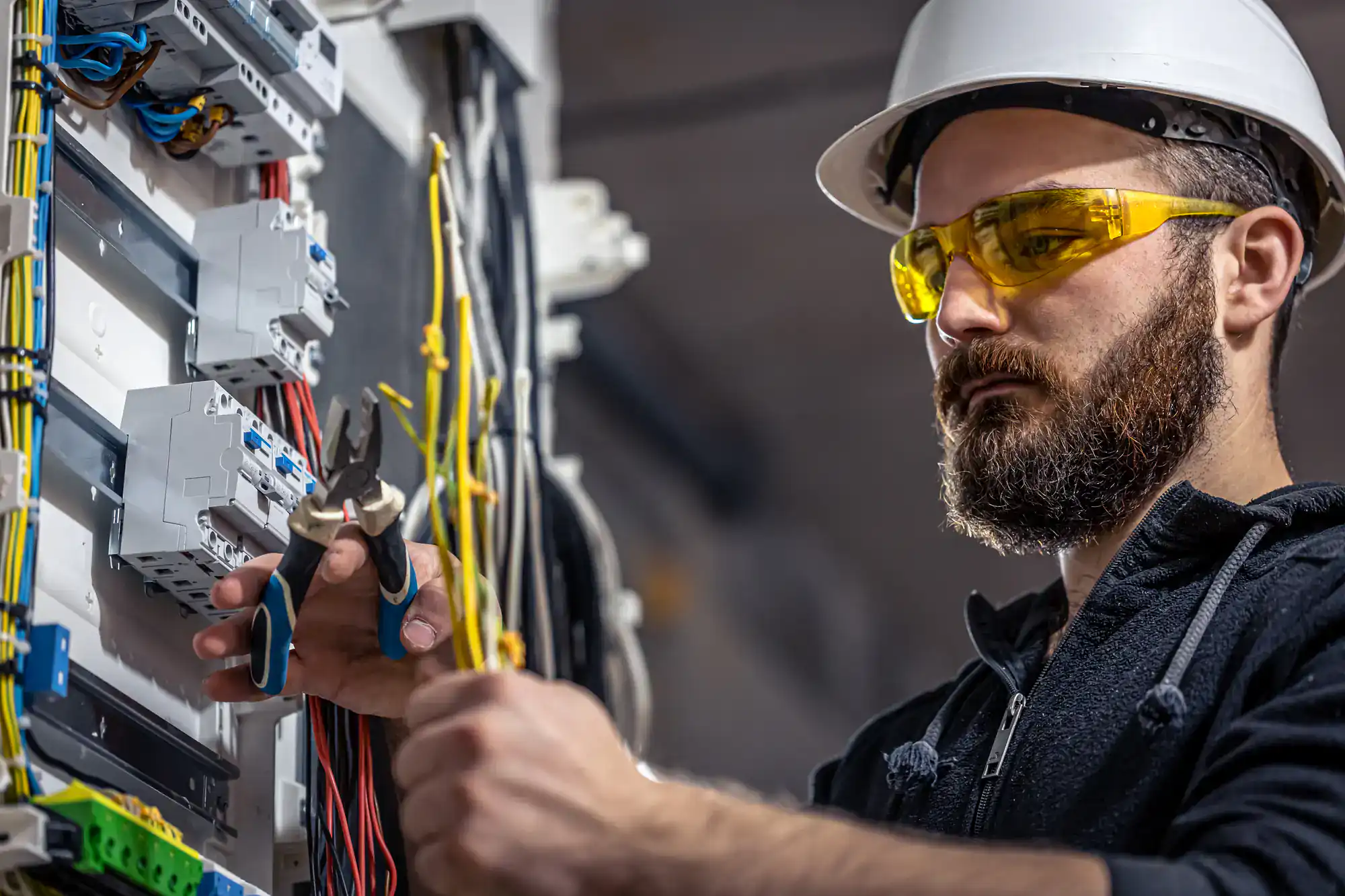
Before any charger goes on the wall, we recommend a licensed electrician assess your panel, perform a load calculation, and confirm what circuit options exist. That step isn’t a formality — it’s the difference between an installation that works long-term and one that trips breakers or creates a safety issue.
This is the question that causes the most anxiety, and the honest answer is: not always — and often not at all.
The fear is understandable. You’ve heard that a panel upgrade can run $1,500 to $4,000 or more, and suddenly a charger installation feels like a major renovation. But that cost only applies when your panel genuinely doesn’t have the capacity to support a new 40- or 48-amp circuit. Many Cook County homes — even older ones — have more headroom than homeowners assume.
When a panel assessment reveals limited capacity, there’s often a solution that doesn’t involve replacing the panel: a load management system. These devices monitor your home’s real-time power consumption and automatically dial back your charger’s draw when other high-demand appliances are running. The result is that your EV still charges overnight — just at a variable rate — without pushing your panel beyond its limits. For homes with moderate existing loads, this approach can eliminate the need for a full service upgrade entirely.
The other scenario worth knowing about: if your home currently has 100-amp service, a panel upgrade may genuinely be necessary — not just for the EV charger, but because 100-amp service is increasingly inadequate for modern home electrical loads in general. In that case, the upgrade is a worthwhile investment regardless of the charger.
Illinois law requires permits for Level 2 charger installations in virtually every Cook County municipality, and each of the county’s 134 municipalities has its own building department and permit process. What’s required in Evanston differs from what’s required in Chicago Heights or Arlington Heights. We know those local requirements — and we pull permits as a matter of course — which protects you from failed inspections, voided insurance claims, and complications when you eventually sell the home.
If you’re a ComEd customer — which covers the vast majority of Cook County — there’s a rebate program worth paying attention to before you buy any equipment. ComEd offers rebates up to $3,750 for qualifying Level 2 smart charger installations. That’s a significant offset against total project cost, but it comes with specific requirements that are easy to miss.
The charger must be WiFi-enabled and purchased on or after February 1, 2024. The installation must be performed by an Illinois Commerce Commission (ICC)-certified EV service provider — a designation required by Illinois law (220 ILCS 5/3-105) that not every local electrician holds. Qualifying chargers include the ChargePoint Home Flex, Tesla Wall Connector (Gen 3 and newer), JuiceBox 40, and Emporia Smart EV Charger, among others. We’re ICC-certified, which means your installation qualifies for the rebate from day one.
Beyond rebate eligibility, smart charger features have real practical value. WiFi connectivity lets you schedule charging during off-peak hours when ComEd’s rates are lower — which in Illinois can meaningfully reduce your monthly electricity cost over time. You can also monitor energy usage, set charge limits to protect battery longevity, and receive alerts if something interrupts a charging session. These aren’t gimmicks. For anyone who drives daily and charges every night, having visibility into that process is genuinely useful.
There’s also a federal tax credit available for qualifying installations through June 30, 2026 — up to $1,000 (30 percent of installation costs) for installations in qualifying census tracts as defined by the IRS. Whether your address qualifies depends on its classification, so it’s worth confirming before assuming the credit applies.
One more thing specific to Cook County winters: Illinois cold reduces EV battery range by 20 to 40 percent in extreme temperatures. When it’s negative ten degrees in January and your range is already compromised, the last thing you want is to be depending on an outdoor public charging station. A home charging point that works every night, regardless of weather, isn’t a luxury in northern Illinois — it’s the practical foundation of EV ownership here.
The equipment decision isn’t complicated once you have the right information. Most Cook County EV owners are best served by a hardwired Level 2 charger in the 32- to 48-amp range, installed on a dedicated 240-volt circuit, with smart features that qualify for the ComEd rebate. The specifics — which charger, which amperage, whether your panel needs attention — depend on your vehicle, your home, and how you drive.
What matters most is getting a real assessment before committing to anything. A load calculation takes the guesswork out of the panel question. An ICC-certified installer protects your rebate eligibility. And pulling the proper permits protects your home, your insurance, and your investment.
We’ve been installing EV chargers in Cook County since 1999, and we know these homes — the older panels, the permit quirks across 134 municipalities, and what actually holds up long-term. If you’re ready to move forward or just want a straight answer about what your home needs, reach out to Jimco Electric and we’ll start there.
Article details:
Share:
Continue learning: